

[:es]
El proyecto
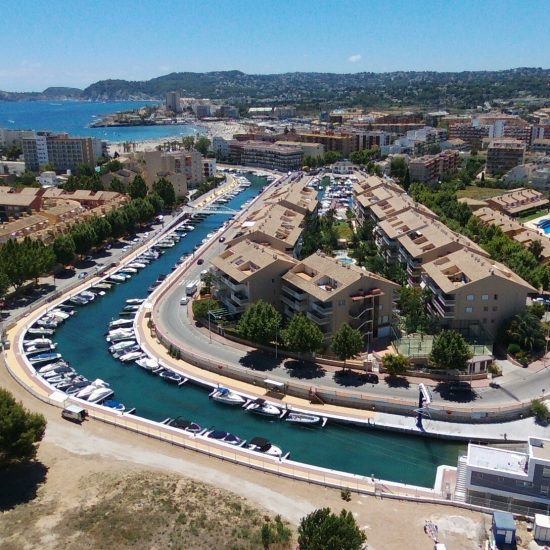
Marina Nou Fontana S.L. ha acometido el Proyecto de Acondicionamiento del Canal de la Fontana (Xàbia-Alicante) como Instalación Náutico Deportiva, adecuando la estructura existente y haciéndola compatible con la actual Marina interior en funcionamiento, con acceso directo por el Canal.
El Canal tiene una longitud aproximada de unos 800 m, y en él se ha construido una línea de muelle nueva con unos 318 amarres. Además en la bocana se ha llevado a cabo una intervención con objeto de asegurar la entrada y salida de las embarcaciones. En la cola del Canal se ha construido un área de varadero con servicio de grúa, un edificio de servicios y una nueva rampa.

02
AMARRES
La distribución de amarres adoptada en el Proyecto de Acondicionamiento del Canal de La Fontana (318 amarres aproximadamente de entre 5 y 9,19 metros de eslora total) consigue una elevada ocupación del espejo de agua optimizando su utilización, a la vez que garantiza un alto nivel de funcionalidad de las instalaciones. La mencionada optimización, es una condición exigible en el diseño, dada la elevada demanda de amarres a satisfacer por nuestra instalación.
Para ello se ha elegido el atraque en punta con amarre a palanca lateral en la mayor parte del Canal, aunque existen también amarres de costado. Entre las múltiples ventajas del atraque en punta, aún a costa de su mayor coste en general, figura la de permitir la eliminación de los trenes de fondeo, con lo que se maximiza la anchura efectiva del canal de navegación delimitando los puestos de atraque.
01
The project
The project currently carried out by Marina Nou Fontana S.L. has the objective of reconditioning the Canal de la Fontana (Xàbia-Alicante) as a nautical and water sports center and remodeling the existing facilities so they can be compatible with the current inner nautical port, as you can have direct access to it through the Canal.
The Canal is around 800 m long, and will host a new quay line with 318 berths (number susceptible to be modified according to the changes that may be introduced in the project). The estuary is going to be remodeled too, with the aim of securing the entries and exits of boats. In the rear part of the Canal there will be a dry dock area.


02
MOORINGS
The berths distribution designed in the Reconditioning Project of the Canal de la Fontana (318 berths from 5 to 9 meters long, susceptible to be modified according to the changes that may be introduced in the Project) favors a high occupation of the water mirror, which optimizes its use, as it guarantees a high level of performance of the facilities. This optimization is a required condition of the design, due to the high level of berths demand that needs to be satisfied by our center.
For this reason, it has been decided to choose bow-to or stern-to berths with lateral levers in almost all the Canal area, although there are also alongside berths. One of the numerous advantages of the bow-to or stern-to berths, despite its higher cost, is the possibility of eliminating the anchorage train, which maximizes the effective width of the navigation canal delimited by the mooring posts.
01
Le projet
Le projet en cours de Marina Nou Fontana S.L. a pour objectif l’aménagement du canal de la Fontana (Xàbia-Alicante) comme installation nautique sportive en même temps qu’il le rend compatible avec la Marina intérieure en fonctionnement actuellement, puisque l’accès à celle-ci se fait directement par le canal.
Le canal a une longueur approximative de 800 m, le long desquels est en cours de construction une file de quais d’accostage avec 318 postes (ce nombre pourrait être revu en fonction des modifications susceptibles d’être apportées au projet). Par ailleurs, une intervention aura lieu dans l’embouchure afin d’assurer l’entrée et la sortie des embarcations. À la sortie du canal sera construite une zone de chantier.
02
AMARRAGES
La distribution des postes d’amarrage adoptée pour le projet d’aménagement du canal de La Fontana (318 postes entre 5 et 9 mètres de long, ce nombre pouvant varier en fonction des changements que pourrait connaître le projet) permet un taux d’occupation élevé du plan d’eau pour optimiser son utilisation, tout en assurant un haut niveau de fonctionnalité des installations. Ladite optimisation est une condition à introduire dès la conception, compte tenu de la forte demande pour l’amarrage que doivent satisfaire nos installations.
Pour ce faire, l’on a choisi l’accostage perpendiculaire avec amarrage à un levier latéral sur la plus grande partie du port. Il existe néanmoins des postes d’amarrage parallèles. L’un des nombreux avantages de l’amarrage perpendiculaire, malgré son coût plus élevé, est de permettre l’élimination du mouillage, en délimitant le poste d’amarrage, ce qui permet de maximiser la largeur effective du canal de navigation en délimitant les postes d’amarrage.